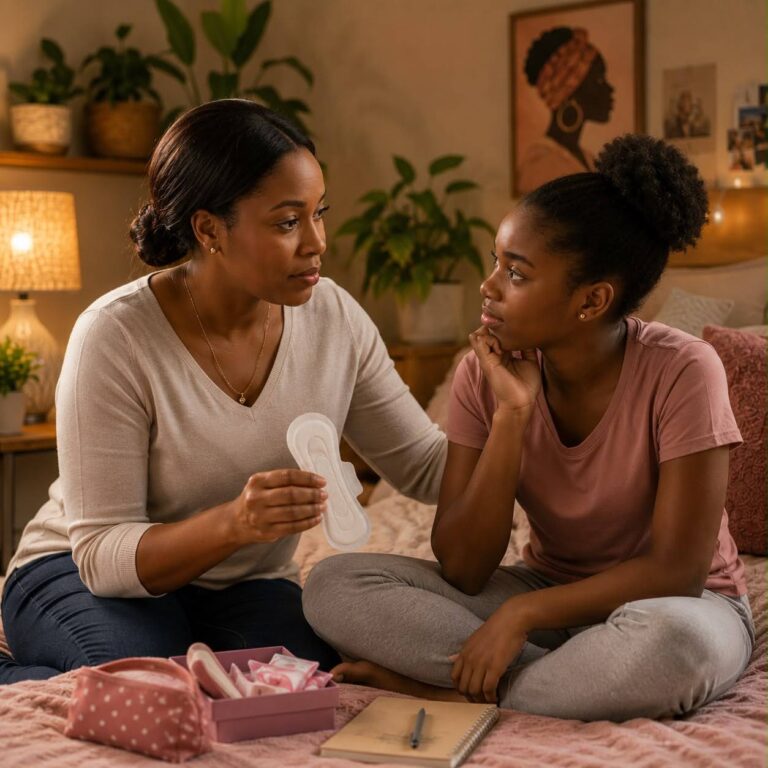
Talking to your daughters about menstruation and sexual health
The Conversation That Changes Everything
She was twelve when it happened at school, during third period. No warning, no preparation. Zara rushed to the bathroom, heart pounding, and didn’t know what to do. She hadn’t been told. No one had talked to her about it.
Millions of girls share Zara’s story. And yet, the conversation that could have protected her is one many families still avoid.
Why the Silence Hurts
Menstruation is a normal biological process and an important sign of reproductive health for many girls and women. According to the World Health Organization (WHO), inadequate menstrual health education contributes to school absenteeism, anxiety, and long-term reproductive health challenges (WHO, 2022).
Beyond periods, girls entering puberty need accurate, age-appropriate information about their sexual health, including body autonomy, consent, hygiene, and recognising abnormal symptoms. Without it, they are left to piece together answers from peers or unreliable online sources.
The Cost of Staying Silent
When girls lack proper knowledge, the consequences are real:
- Emotional distress: Shame, fear, and confusion around their bodies
- Health risks: Untreated menstrual disorders like dysmenorrhoea or PCOS go unrecognised
- Vulnerability: Poor understanding of consent and body boundaries increases exposure to exploitation
Research published in the Journal of Adolescent Health found that girls who received open, parent-led sexual health education were significantly more likely to make safer health decisions and seek medical help when needed (Dittus et al., 2015).
How to Start the Conversation
You don’t need to have all the answers you need to show up. Here’s how:
Start early and keep it ongoing. Begin with simple, accurate language around ages 8-10. Normalise the topic so it doesn’t feel shameful or sudden.
Use teachable moments. A product commercial, a friend’s experience, or a health class question can open the door naturally.
Be factual and calm. Explain what menstruation is, what to expect, and what products are available. Discuss hygiene basics and when to see a doctor, for example, if periods are extremely painful or irregular.
Talk about body boundaries. Teach her the names of her body parts, the right to say “NO”, and who safe adults are.
Listen more than you speak. Create space for her questions without judgement.
Paediatric health organisations, including the American Academy of Paediatrics, recommend that parents initiate these conversations and revisit them regularly as children grow (AAP, 2021).
You Are Her First Safe Space
Your daughter doesn’t need a perfect speech, she needs to know she can come to you. When you speak openly, you give her something more powerful than information: you give her confidence, safety, and trust in her own body.
The conversation may feel uncomfortable. Having it anyway is one of the most important things you’ll ever do.
References
- World Health Organization. (2022). Menstrual health and hygiene. https://www.who.int
- Dittus, P. J., et al. (2015). Parental monitoring and adolescent sexual behaviour. Journal of Adolescent Health, 57(1), 78–84.
- American Academy of Pediatrics. (2021). Talking to your kids about puberty. https://www.healthychildren.org