
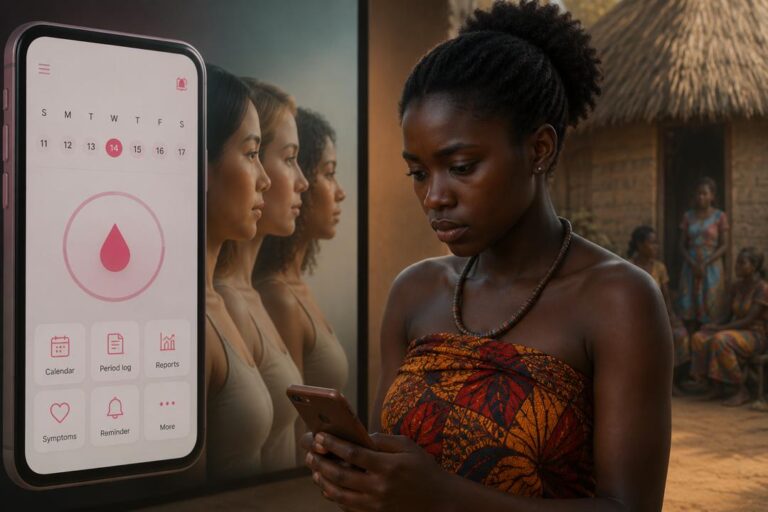
Let’s imagine this for a minute.
You are 22 weeks pregnant in Lagos. The baby just kicked. It’s 2 a.m. and you can’t sleep. You open the pregnancy app you downloaded the day you saw two lines on the test, and you tap on this week’s update.
It tells you to start your morning with avocado on sourdough toast. To stock up on quinoa, kale, and salmon. To take your prenatal vitamins with a glass of cold-pressed juice.
You close the app.
You are not in Brooklyn. You are in Surulere. You eat ogi for breakfast and buy your tomatoes from Mama Bose at the corner stall. The app doesn’t know any of that. It wasn’t built for you.
This is the small, daily friction. The bigger problem is hiding underneath it.
Mortal Rate Statistics of the African Female
A woman in Nigeria has a 1 in 19 lifetime risk of dying from pregnancy or childbirth.
In most developed countries, that number is 1 in 4,900, like the UK and the US
Read those again; it should send a signal to you.
Nigeria carries roughly 28 per cent of all maternal deaths on the planet. The leading killers are hypertension, sepsis, haemorrhage, and anaemia. Most of these are preventable if caught early. Most of these are not flagged with any urgency in apps designed for women whose hospitals are five minutes away and whose haemoglobin levels were never the issue.
Even if you make it to the UK as part of the African diaspora, the gap follows you. According to the latest MBRRACE-UK data, Black women in Britain are two to three times more likely to die from pregnancy-related causes than white women. Earlier reports put that gap at four times higher. This is not just an African problem. It is a Black woman’s problem in any healthcare system that wasn’t built with her body, her risks, and her life in mind.
Mainstream period and pregnancy apps were not built with these stakes in mind. They were built for women whose bodies finally became part of US medical research in 1993, after being legally excluded from clinical trials for nearly two decades. If white Western women had to fight for inclusion in that data, where do you think Black and African women sat on the priority list?
Right at the very bottom. Still.
This is the gap Dr Patience Amos walked into.
What Dr Patience Amos is Building
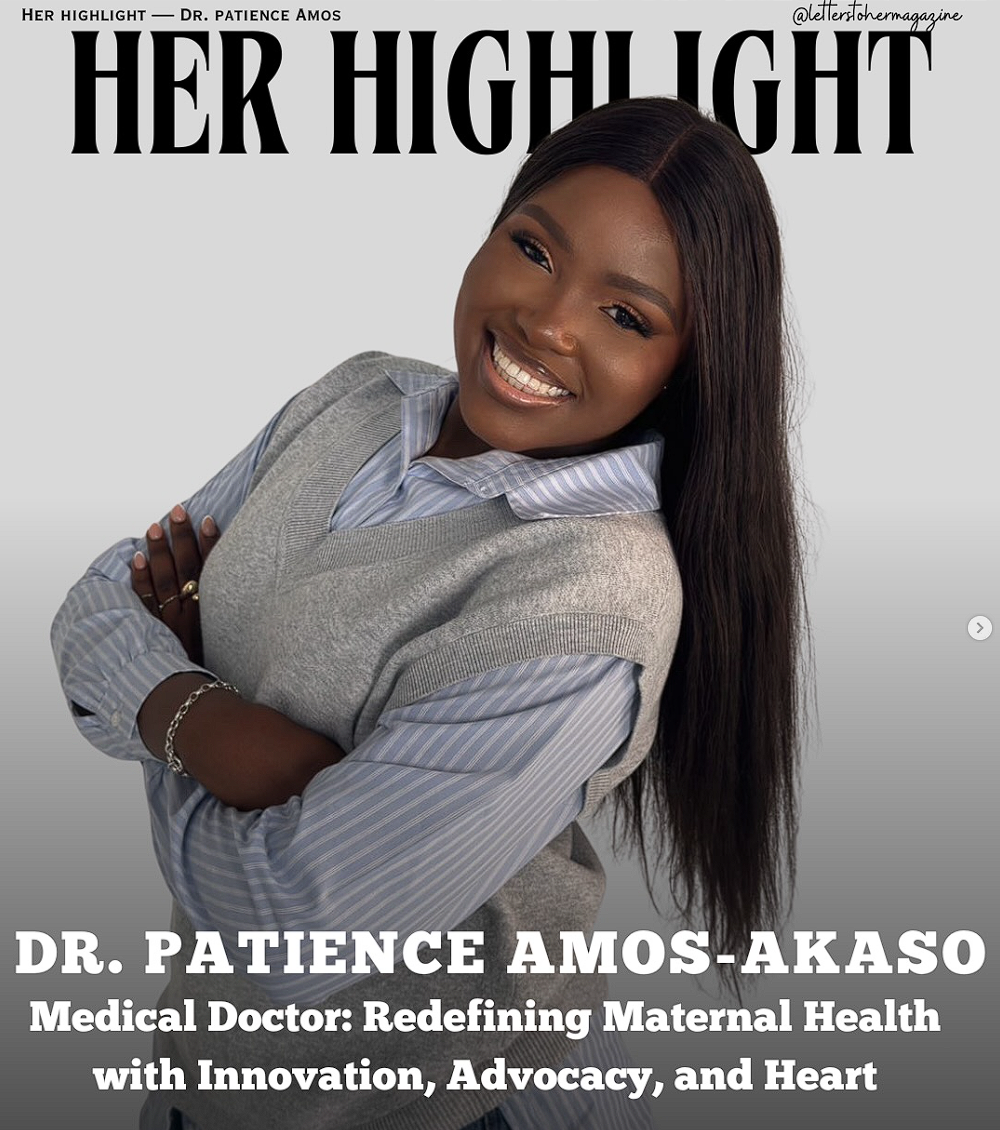
Dr Patience Amos is a medical doctor and public health specialist. She’s also the founder of MyLurah, a femtech platform built specifically for Black and African women through every stage of menstruation, pregnancy, and postpartum care.
Her parallel work runs through the Mom and Me Foundation, a CAC-registered Nigerian NGO based in Abuja, focused on maternal and child health in underserved communities, with active programmes in northern Nigeria. The foundation tackles the root causes of high maternal mortality and morbidity through evidence-based public health work, aligned with UN Sustainable Development Goals 3 and 4.
She is currently in the UK, moving through accelerator programmes and building MyLurah for women across the continent and the diaspora.
Hers is the kind of CV global femtech keeps overlooking.
She didn’t build MyLurah because she spotted a market. She built it because she watched the gap hurt people.
“It wasn’t one dramatic moment,” she tells me. “It was a pattern I kept seeing, again and again. As a doctor, I noticed a disconnect between what women were experiencing and what digital tools were telling them. Then I looked at the apps themselves, Flo and Clue, and I realised they were built on datasets, lifestyles, and assumptions that don’t reflect African women.”
“That’s when it clicked,” she says.
“We weren’t just under-represented in healthcare systems. We were invisible in the tools meant to support us daily.”
If the foundation is wrong, she says, the guidance will always feel slightly off. And when the body in question is one already let down by the global health system, ‘slightly off’ becomes dangerous fast.
What “off” really looks like
When women were excluded from medical research for decades, real consequences followed. Today, women are still 50 per cent more likely than men to be misdiagnosed during a heart attack, because the textbooks were written from male bodies and male symptoms. That is what happens when an entire population is built around a default that is not you.
Now stack that on top of being a Black African woman whose data was rarely collected at all.
The cracks in mainstream period and pregnancy apps for African users are not theoretical. They show up in three concrete places.
- The food advice: “You’ll see suggestions like salmon, quinoa, or kale-based meals,” Dr Patience says, “without any translation into foods women actually eat daily in places like Kenya or Ghana.” Egusi. Ogbono. Jollof rice with vegetables. Beans and plantain. Yams and palm oil. The actual diet of the actual user. Nowhere on the screen.
- The symptom guidance: Fatigue. Pelvic pain. Postpartum bleeding. These get treated as flat, universal experiences. They are not. A woman in rural Nigeria carrying anaemia, working through pregnancy, booking late for antenatal care, with a half-day journey to the nearest clinic, is reading those symptoms in a completely different context. The app does not know that. The app does not ask.
- The language: These apps assume a level of health literacy and access that doesn’t exist for everyone. They speak like wellness influencers, not friends. As Dr Patience puts it, “they don’t speak to African women, they speak around them.”
That phrase has stayed with me since she said it. They speak around us.
The risks the app misses while you scroll
Anaemia in pregnancy is one of the most common conditions African women face. Most digital tools don’t treat it as a serious, ongoing risk. They flag it as a tile to read about, then move on.
Postpartum care is the bigger blind spot.
“Globally, there’s a tendency to focus heavily on pregnancy, and then almost abandon women after delivery,” Dr. Patience says. “But in many African settings, that postpartum period is where risk is highest. From infections to haemorrhage to mental health challenges.”
Then there’s the access reality. Many women don’t present early to clinics. Not because they don’t care, but because of cost, distance, or family dynamics. Most apps assume early, consistent engagement with the healthcare system, the kind of engagement that requires money, time, and a clinic down the road.
The whole digital infrastructure for women’s health was built for somebody else’s mother. Somebody else’s sister. Somebody else’s wife.
“The baseline assumptions behind these apps,” she says, “don’t match lived reality.”
Building from culture, not against it
Here is what most femtech apps do when they think about Africa: they take a Western product, translate the language, swap a couple of food images, and call it inclusive. That isn’t building for African women. That’s repackaging a cake nobody asked for and putting your name on the box.
Dr. Patience is doing something different.
“MyLurah is being built from lived context, not adapted into it.”
That sentence is the company’s entire thesis. The app starts from how African women actually live, eat, recover, and seek care.
Take omugwo, the Igbo postpartum care tradition that begins shortly after delivery and runs anywhere from one to six months. The new mother’s own mother, or sometimes her mother-in-law, moves in. She handles bathing the baby, soothing it, the massages, the feeding. She prepares food meant to support recovery and breast milk: pepper soup, pap, dishes seasoned with uda and uziza. She runs the hot water therapy and sitz baths. The new mother is meant to rest. To heal. To be cared for.
Yoruba families call it itoju omo. Annang families call it umaan. Almost every Nigerian culture has a version of this. So do many other African and Caribbean cultures.
A mainstream app simply does not see this. At best, it ignores the practice. At worst, it speaks past it with advice about brisk walks and meal prep for the week. MyLurah acknowledges the practice. Then it bridges it with evidence based clinical guidance about what to monitor, what to escalate, and when to seek medical help.
“The app doesn’t try to replace culture. It works with it.”
That single move, designing with culture instead of against it, is rarer than it should be. It is also the only way this kind of product actually works.
How that shows up inside the app
So what does this look like when you actually open MyLurah?
It tracks your cycle, your pregnancy, and your postpartum recovery, week by week, with predictions that learn from your body rather than a Western template. It logs symptoms with interpretations grounded in African clinical realities, including the conditions mainstream apps overlook. The nutrition guidance reflects what is actually on your table, not what is on a Brooklyn shopping list. It flags danger signs that matter most in our context, like anaemia in pregnancy, postpartum haemorrhage warning signs, and late presentation risks. And it gives you a private community of women navigating the same questions you are.
It speaks to you. Not around you.
Where MyLurah sits in a wider picture
MyLurah isn’t the first piece of femtech built for Africa. Kasha, founded in Rwanda in 2016, raised $21 million in Series B funding to deliver health and personal care products to women across Kenya and Rwanda. South Africa’s Zoie Health is building virtual women’s care. Ethiopia’s YeneHealth has a period and pregnancy tracking app rooted in the local context.
But here is the data that matters. According to a recent industry analysis, around 81 per cent of funded African femtech startups focus on fertility. Postpartum care, the very stretch of time where African women are most at risk of dying, is the most glaring gap.
That is the part of the map MyLurah is staking its flag in.
What success actually looks like
When I asked Dr. Patience what success looks like for MyLurah, she didn’t talk about downloads. She didn’t talk about valuations. She said this:
“It’s when a woman in Gombe, Lagos, or even in the diaspora opens the app and feels like, this was made for me.”
She wants earlier care seeking. Better symptom recognition. Decisions made with proper information. Not because women are being told what to do, but because they finally have a tool that makes sense in their world.
The bigger ambition is bigger than an app. It is a shift in how the global health system sees African women.
“From African women being data gaps, to becoming the standard around which solutions are built.”
I asked her if that felt realistic. She didn’t blink.
“The goal isn’t to catch up. It’s to finally design from where we are.”
The line that should be on a wall somewhere
Design from where we are.
If you have read this far, you already know the gap is not just about apps. It is about who gets to be counted as a default human in a global system. For too long, that default has not included Black and African women. The femtech revolution has been celebrated, the funding has been raised, the conferences have been held, and a Nigerian woman 22 weeks pregnant in Surulere is still being told to eat avocado toast at 2 a.m.
MyLurah is one woman’s answer to that. A real one. A clinical one. An African One. A Nigerian one.
That is why this matters.
If you are an African woman reading this and the app you have been using has always felt slightly off, you weren’t imagining it. There is finally one being built with you in mind from the first line of code.
If your app has always felt like it was built for someone else, try the one that was built for you. Download the Mylurah app from the Google Play Store or the iOS App Store to start. Also, follow Dr Patience Amos on Instagram at @patienceinspire and join the WhatsApp community through the link in her bio.


That’s a great job Dr Patience. I am a Registered Nurse and a Midwife and a maternal and child health specialist in Northeast Nigeria and will like to be a part of your team in ensuring this vision for a better maternal and child health outcome in the Northeast.