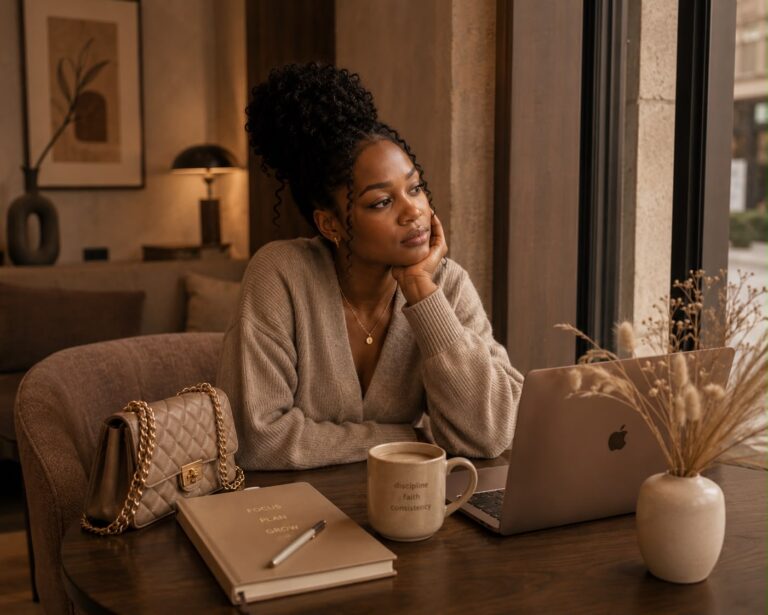
You matched with someone new, and within the first few messages, he asked what he’s really wanting to know: “Where are you from… originally?” Then came the compliments how “exotic” you look, how he’s “always wanted to date an African woman,” how your accent is “so cute.” You came here hoping for connection. What you got instead was a checklist of things you didn’t sign up to represent.
Later that night, you call home, and your mother asks when you’re bringing someone back to meet the family as if the version of dating happening here maps neatly onto the one she understands. It doesn’t. And you’re left holding both realities at once, unsure which one you’re supposed to be performing.
What Is This Really About?
This is about the gap between the dating life you imagined abroad, expanded options, more freedom, a wider pool of connection and the dating life you actually encounter, which often comes wrapped in stereotypes, fetishization, and unfamiliar cultural rules, while your family back home still expects you to operate by the old ones. It’s not that dating abroad is worse. It’s that it’s more complicated than anyone tells you before you get there.
What Dating as an African Woman Actually Shows
This isn’t just personal experience, it’s a documented pattern researchers have studied specifically among Black and African women navigating dating in Western countries.
Research on Black women’s dating app experiences found that their pursuit of connection is shaped by algorithms, racial discrimination, and persistent stereotypes that complicate the search for genuine intimacy [1]. That complication often shows up as fetishization rather than outright rejection.
Studies of Black women’s dating experiences describe a specific pattern where women are approached with hypersexualized attention tied directly to racial and ethnic features, treated less as individuals and more as the fulfillment of a preconceived fantasy [2] the “exotic” comment isn’t a compliment in disguise; it’s a documented dynamic with a name.
Desirability itself is measurably shaped by race. Research on dating attraction has found Black women are frequently among the least prioritized groups in dating markets shaped by racialized preference hierarchies [3] a structural reality, not a reflection of individual worth, though it rarely feels that way in the moment.
Meanwhile, the pull from home doesn’t disappear just because you’ve relocated. Research on African immigrant women found that maintaining ties with extended family back home functions as both a vital source of support and a genuine source of strain, often complicating women’s ability to restructure their lives on their own terms in a new country [4]. You’re not imagining the tension. It’s a documented part of the transition.
Instead Do: Name the Pattern So It Stops Feeling Personal
The first shift is recognizing that fetishizing comments and dismissive treatment reflect a pattern operating on entire groups of women, not a verdict on you specifically. That reframe doesn’t erase the sting, but it changes what you do with it: instead of internalizing it, you can screen for it early.
At MyLurah, we believe every woman deserves to feel informed, supported, and understood throughout every stage of her reproductive journey. From navigating periods and understanding her body to preparing for pregnancy and adjusting to life after birth, we create a safe space for culturally informed education, meaningful conversations, and community support.
A question like “what made you interested in me” often reveals within minutes whether someone sees a person or a projection.
Second, give yourself permission to build a dating framework that’s genuinely yours not a rejection of home’s expectations, not a full adoption of the new culture’s norms, but something assembled deliberately from both. You get to decide what you’re willing to explain, what you’re not, and when family involvement happens on your timeline instead of theirs.
And find your people before you need them other women navigating the same dual reality tend to spot the patterns faster and name them sooner than you will alone. This isn’t a problem to solve quietly. It’s one that gets lighter the moment you stop carrying it by yourself.
References
- What’s algorithms got to do with it? Exploring Black Women’s pursuit of Black love on dating apps (2025). ScienceDirect. https://www.sciencedirect.com/science/article/abs/pii/S2211695825000303
- The Dating Experiences of Black Women. LMU Digital Commons. https://digitalcommons.lmu.edu/cgi/viewcontent.cgi?article=1001&context=wgst_thesis
- Race and Desirability: Black Women in the Dating Scene. PDXScholar, McNair Symposium. https://pdxscholar.library.pdx.edu/mcnairsymposium/2020/presentations/12/
- Okeke-Ihejirika, P., Punjani, N. S., & Salami, B. (2022). African Immigrant’s Women Experiences on Extended Family Relations. International Journal of Environmental Research and Public Health, 19(14), 8487. https://doi.org/10.3390/ijerph19148487