“Why Don’t You Speak Yoruba Like Grandma?”
Ten-year-old Tomi looked confused when her grandmother spoke to her in Yoruba during a visit. She understood almost nothing.
Her parents, both fluent speakers, had unintentionally stopped using the language at home with busy schedules, English speaking schools, and convenience. No one decided to let it go. It simply slipped away.
Culture isn’t only lost through dramatic rupture. More often, it fades quietly, one skipped tradition, one untold story at a time.
Why Culture Doesn’t Transmit Itself
Many parents assume children will simply “absorb” culture by living in a household that has it. But research on intergenerational transmission shows that values, beliefs, and practices are passed down through active processes of modelling, direct teaching, and consistent reinforcement, not passive exposure alone, as parents intentionally influence the values of their offspring.
Scholars distinguish between transmission that happens because adults deliberately teach the next generation versus outcomes that occur simply because children are exposed to the same environment as their parents.
True cultural transmission requires that adults intentionally teach the younger generation or that the younger generation actively imitates adults.
Without intention, culture doesn’t automatically survive contact with a new generation.
What Gets Lost in the Silence
When cultural transmission is left unconscious rather than deliberate, families often notice the gap only after it has widened:
- Language fades first, often within a single generation, especially in households balancing multiple cultural or linguistic environments.
- Identity confusion can follow, particularly for children in bicultural families navigating both heritage and host-culture expectations, as they work to preserve, adapt, and integrate both worlds [1].
- Traditions become symbolic rather than lived, celebrated occasionally but disconnected from deeper meaning or daily practice.
Researchers studying bicultural families found that intentional effort was central to how successfully families preserved cultural heritage while adapting to a new environment [1b].
At MyLurah, we believe every woman deserves to feel informed, supported, and understood throughout every stage of her reproductive journey. From navigating periods and understanding her body to preparing for pregnancy and adjusting to life after birth, we create a safe space for culturally informed education, meaningful conversations, and community support.
Making Culture a Choice, Not an Accident
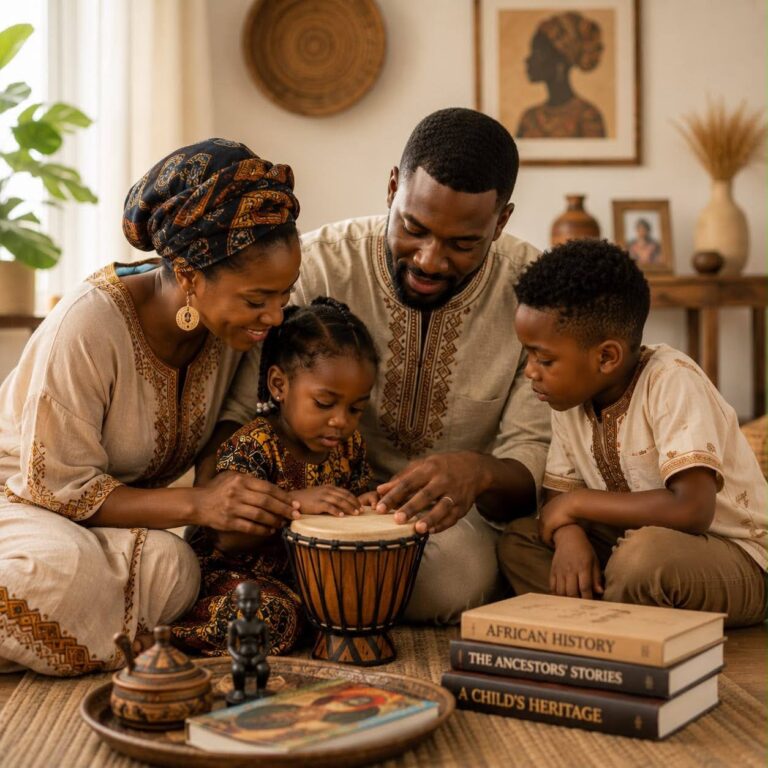
Passing down culture intentionally doesn’t require perfection, it requires consistency and presence.
Speak the language, even imperfectly. Regular use at home matters more than fluency alone.
Narrate the “why”, not just the “what”. Explain the meaning behind traditions, not just the steps.
Create rituals, not just events. Weekly practices embed culture more deeply than occasional celebrations.
Involve elders directly. Grandparents and extended family are often the richest and most time-limited sources of cultural knowledge.
Let children ask questions. Two-way engagement strengthens retention far more than one-directional instruction.
Research also shows that a warm, autonomy-supportive parenting style rather than strict control is associated with stronger, more lasting value transmission [2].
Culture Is a Gift, Not a Given
Culture isn’t inherited by default, it’s carried forward by the people willing to teach it.
What you name intentionally, your children are far more likely to keep. What you leave to chance, time will quietly take away.
References
- Namjoo, F., Herawati, N., & Bhat, R. H. (2023). Intergenerational Transmission of Cultural Values in Bicultural Families. Journal of Psychosociological Research in Family and Culture. https://journals.kmanpub.com/index.php/jprfc/article/download/2605/3626/9455
- Copen, C., & Silverstein, M. (2012). Intergenerational transmission of values over the family life course. ScienceDirect. https://www.sciencedirect.com/science/article/abs/pii/S1040260812000305