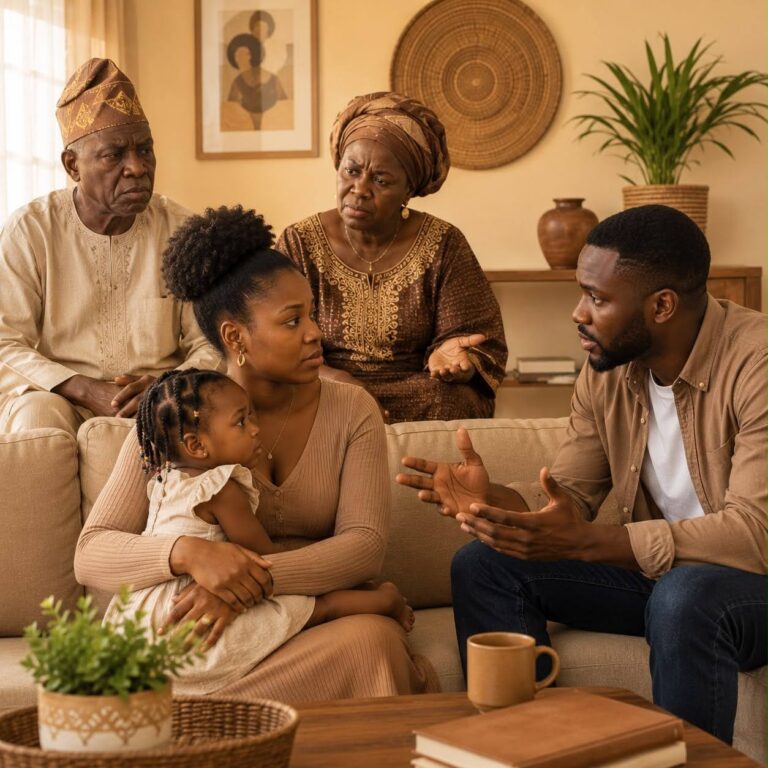
Ngozi hadn’t spoken to her ex-husband in three weeks. Their seven-year-old son, Emeka, carried messages between them, a small boy shouldering adult burdens.
Meanwhile, Emeka’s paternal grandmother insisted on raising him “the proper way”, while Ngozi embraced a gentler, more communicative style she’d read about online. Between three households and two parenting philosophies, Emeka grew quieter every day.
This story, painfully familiar across the African continent, sits at the intersection of love, tradition, and an evolving world.
Co-parenting in Africa is undergoing a massive shift as families blend age-old communal traditions with modern, nuclear-family approaches.
While traditional methods emphasize extended family networks and strict discipline, modern co-parenting leans toward shared parental responsibilities, open emotional communication, and child-centric decision-making
Tradition Meets Transition
African child-rearing has long been grounded in a powerful communal philosophy. The proverb “it takes a village to raise a child” is not just poetry; it describes a genuine system of shared responsibility, where grandparents, aunts, uncles, and community elders actively shape a child’s values, identity, and discipline. In collectivist African cultures, the community plays a central role in child-rearing, with extended family networks grandparents, aunts, and others forming the backbone of a child’s upbringing.
But today’s African families are navigating a significant shift. Young parents are moving away from their villages for work, leaving behind the support systems that once defined child-rearing. In urban settings, the communal model weakens, and children grow up with less exposure to extended family influence. At the same time, digital exposure is introducing new parenting philosophies gentle parenting, emotional validation, and child autonomy that sometimes sit uneasily alongside traditional expectations of obedience and communal hierarchy.
When parents separate in this climate, the tension between these two worlds intensifies. Who decides how a child is disciplined? Whose cultural framework prevails? And crucially, who speaks for the child?
The Hidden Cost of Parental Conflict
The greatest risk in this cultural tug-of-war is not tradition itself it is unresolved conflict. High-frequency parental conflict has a significant negative impact on children’s mental health, causing both parties to focus on their disputes rather than their children’s needs. Research confirms that exposure to verbal arguments, emotional neglect, and household tension contributes to increased anxiety, depression, low self-esteem, and poor academic performance in children.
Children like Emeka don’t need to understand adult conflict to be harmed by it. They simply absorb it in silence, withdrawal, and anxiety.
A Path Forward: Blending, Not Breaking
Navigating co-parenting across cultural expectations requires intentional strategies:
Separate the role from the relationship. You may no longer be partners, but you remain parents. Commit to that shared responsibility with professionalism and consistency.
Create a co-parenting agreement. Document shared expectations around discipline, education, cultural practices, and healthcare. Written clarity prevents repeated conflict.
Honour extended family with boundaries. Traditional African child-rearing practices carry genuine value; practitioners working with families should learn about these customs rather than dismissing them in favour of Western models. Grandparents and elders can remain influential without overriding parental authority.
Blend rather than battle. Many African parents today are navigating a hybrid parenting style, blending traditional values with modern approaches, and this integration, done thoughtfully, can give children the best of both worlds.
Seek professional support early. Family counsellors familiar with African cultural contexts can help parents develop co-parenting plans that respect heritage while prioritising child wellbeing.
At MyLurah, we believe every woman deserves to feel informed, supported, and understood throughout every stage of her reproductive journey. From navigating periods and understanding her body to preparing for pregnancy and adjusting to life after birth, we create a safe space for culturally informed education, meaningful conversations, and community support.
Your Child Is Watching
Children raised amid co-parenting conflict don’t need a perfect family structure they need parents who choose their wellbeing over their disputes. The village may have changed shape, but its purpose remains the same: to surround a child with safety, love, and belonging.
That village can still be built even across two homes, two viewpoints, and two generations.
References
- Amodu, O., Armoush, N., & Salami, O. (2026). Parenting values of African immigrants. Journal of Family Issues. https://doi.org/10.1177/0192513X251362450
- Berg, A. (2020). Diversity and the positive impact of culture. WAIMH Perspectives. https://perspectives.waimh.org
- Deng, M., & Li, X. (2024). Parental conflict and adolescents’ socially adverse emotions. Frontiers in Psychology, 15, 1387698. https://doi.org/10.3389/fpsyg.2024.1387698
- Maharjan, S. (2025). Impact of parental conflict on children’s mental health. BATUK, 11(2). https://doi.org/10.3126/batuk.v11i2.82375
- Monitor Correspondent. (2026, April). Will African parenting survive the next 100 years? Daily Monitor. https://www.monitor.co.ug