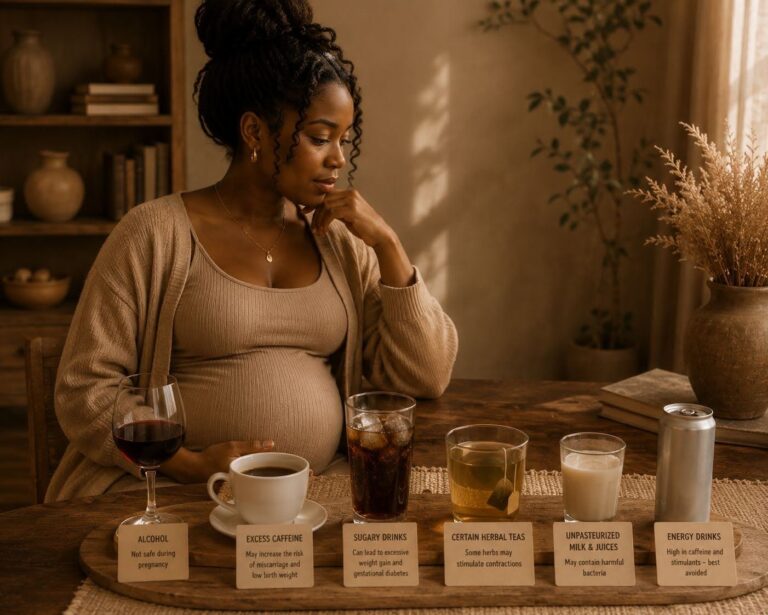
Nobody tells you about the quiet guilt of reaching for a cold Coke at 10am because the nausea has made eating impossible. Or the cup of tea that feels like the only thing standing between you and complete exhaustion at week fourteen.
Pregnancy changes your relationship with everything including what you drink. And for Black women, who already carry a disproportionate burden of pregnancy-related complications, the drinks in your hand matter more than anyone in a clinic waiting room may have taken the time to tell you.
Which Drinks Are Actually Harmful During Pregnancy?
Alcohol, there is no safe amount.
This one is not a grey area. There is no known safe amount of alcohol during pregnancy or when trying to get pregnant. There is also no safe time to drink during pregnancy alcohol passes directly to your baby through the umbilical cord. ¹ CDC
Fetal Alcohol Spectrum Disorders (FASDs) affect behaviour, learning, memory, and physical development and they are entirely preventable. Not one glass of wine. Not one beer. Nothing.
Caffeine, more dangerous than you think.
Your morning coffee, your zobo with energy drink, your strong Lipton tea all of these carry caffeine, and caffeine crosses your placenta directly. Research suggests that higher caffeine intake during pregnancy may be associated with increased risks of miscarriage, low birth weight, and fetal growth restriction, particularly at higher consumption levels. Some studies suggest that risks may begin at relatively low levels of intake, although guidelines generally recommend staying below 200 mg per day ² A meta-analysis of over 90,000 pregnancies confirmed the risk is real and increases with every additional cup.³ nih
Sugar-Sweetened Beverages, the silent risk.
Soft drinks, bottled juice, sweetened malt drinks, and flavoured yoghurt drinks all fall here. High consumption of sugar-sweetened beverages during pregnancy is associated with increased risk of preeclampsia, gestational diabetes, and gestational hypertension and Black women are among those most affected. ⁴ Black women already face three times the maternal mortality rate of white women. High consumption of sugar-sweetened beverages has been associated with increased risk of gestational diabetes, gestational hypertension, and preeclampsia. PubMed Central
At Mylurah we’re building a digital platform that centers Black women’s reproductive journeys, including culturally sensitive support for Period, Pregnancy and Postpartum. Because representation in care isn’t optional, it’s essential.
Energy Drinks, not just caffeine.
Energy drinks carry caffeine, taurine, guarana, and other stimulants whose combined effect on a developing baby remains incompletely understood. Research involving over 7,000 pregnancies found that energy drink intake before pregnancy was associated with an elevated risk of gestational hypertension. ⁵ When your blood pressure is already a risk factor, this is not a drink worth gambling on. PubMed Central
In All You Do
Choose your drinks like they matter because they do. Black pregnant women deserve information that is honest, direct, and culturally grounded, not watered down or delivered as an afterthought in a clinic corridor.
Every sip you take, your baby takes with you. That is not said to create fear it is said to create clarity. You have the power to protect your baby with choices that cost you nothing but awareness.
Swap the soda for zobo without sugar. Swap the energy drink for cold water with cucumber and mint. Swap the coffee for ginger tea which research confirms also eases pregnancy nausea naturally.
Your body is doing the hardest work of its life. What you drink either supports that work or quietly undermines it.
References
- CDC. (2024). About Fetal Alcohol Spectrum Disorders (FASDs). cdc.gov/fasd/about/index.html
- Golsorkhi, M. et al. (2025). The Fetal Effect of Maternal Caffeine Consumption During Pregnancy — A Review. PMC. pmc.ncbi.nlm.nih.gov/articles/PMC11852448
- Soltani, S. et al. (2023). Maternal Caffeine Consumption During Pregnancy and Risk of Low Birth Weight: A Dose-Response Meta-Analysis. Critical Reviews in Food Science and Nutrition. PubMed. pubmed.ncbi.nlm.nih.gov/34224282
- Kieffer, E.C. et al. (2022). Factors Associated with Beverage Intake in Low-Income, Overweight or Obese Pregnant Women. PMC. pmc.ncbi.nlm.nih.gov/articles/PMC8877862
- Gaskins, A.J. et al. (2023). Intake of Energy Drinks Before and During Pregnancy and Adverse Pregnancy Outcomes. PMC. pmc.ncbi.nlm.nih.gov/articles/PMC10660164