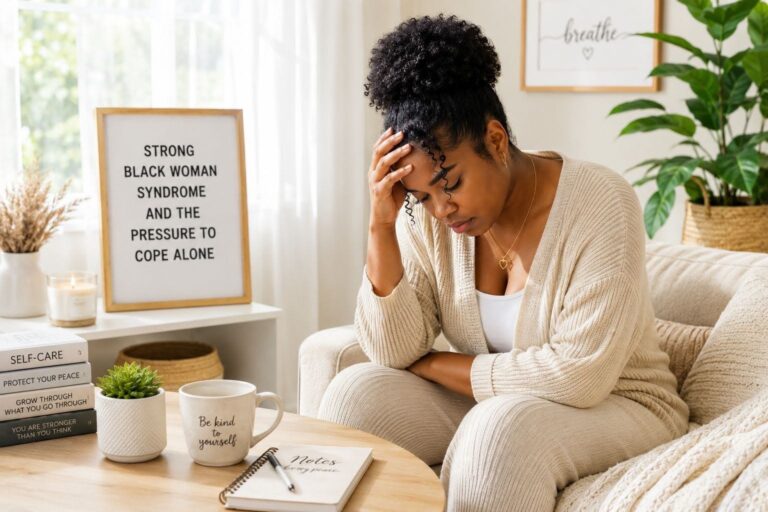
She does not ask for help. She handles it. She shows up for her children, her partner, her workplace, and her community, and she does it all without flinching. From the outside, she is extraordinary. From the inside, she is exhausted. And she has no language for that exhaustion, because everything she has been taught tells her that feeling it means she is weak.
This is the “Strong Black Woman” a construct that carries the weight of centuries. And it is quietly killing Black women.
The Deep Question: Is Strength Protecting Her or Costing Her Life?
Here is the question no one asks the woman holding everything together: What is the price of never breaking down?
A growing body of research suggests the cost can be substantial
The “Strong Black Woman” (SBW) schema also called the Superwoman Schema is not merely a cultural attitude. It is a clinically studied, peer-reviewed phenomenon with measurable physical consequences. Researchers Parks and Hayman (2024) define it in a landmark systematic review as “a statue of unrelenting strength, resilience, and self-sufficiency, serving as a shield of protection and cultural adaptation to suppress and control manifestations of racial and gender oppression.”[¹] The schema has five documented dimensions: the obligation to appear strong, the suppression of emotions, resistance to vulnerability, the drive to succeed despite limited resources, and the compulsion to prioritise others at one’s own expense.[²]
At Mylurah we’re building a digital platform that centers Black women’s reproductive journeys, including culturally sensitive support for Period, Pregnancy and Postpartum. Because representation in care isn’t optional, it’s essential.
These are not virtues operating in a vacuum. They are survival strategies born from generations of oppression and they come at a cost.
A 2024 study published in Annals of Behavioral Medicine, drawing from the FAITH! Heart Health+ Study, found a direct positive association between superwoman schema endorsement and perceived stress levels, cardiovascular risk factors, and poorer overall cardiovascular health in Black women.[³] A separate study from the African American Women’s Heart and Health Study examining 208 women aged 30 to 50 found that the stresses of the superwoman role were directly connected to higher allostatic load, a measure of chronic physiological stress linked to cardiovascular disease, diabetes, and premature mortality.[⁴]
During pregnancy and postpartum, the consequences sharpen. A 2025 PubMed study on 305 pregnant Black American women found that superwoman schema endorsement was significantly associated with higher perceived stress during pregnancy a period when stress is already linked to preterm birth, low birth weight, and poor maternal mental health outcomes.[⁵] Research published in Women’s Health Issues further confirms that the SBW schema shapes how Black women navigate perinatal mental health many experiencing high levels of anxiety and depression that go undisclosed precisely because the schema demands they appear composed.[⁶]
And the silence compounds. The Maternal Mental Health Leadership Alliance confirms that over 50% of postpartum depression cases in women of colour go unreported, and that the pressure of having to be a “strong Black woman” actively prevents many from seeking help.[⁷] The Policy Center for Maternal Mental Health goes further, reporting that nearly 60% of Black mothers receive no treatment or support for prenatal or postnatal mental health complications with sociocultural barriers, including stigma and the equation of help-seeking with weakness, cited as primary drivers.[⁸] A Centre for American Progress report, citing a survey of 114 Black women, found that religious coping was the preferred first response to mental health struggles, with formal professional care sought only as a last resort, if at all.[⁹]
At MyLurah community group, we believe no woman should navigate pregnancy feeling unseen or unsupported. Our platform creates space for culturally informed care, conversation, and community.
This is the architecture of suffering in silence. And it is not a personal failing. It is a structural one built over centuries and reinforced daily by a healthcare system that has historically dismissed Black women’s pain, a culture that celebrates endurance over healing, and a world that rewards Black women for carrying everything except their own needs.
Healing begins when the narrative shifts. Not from strength to weakness but from silence to honesty. She does not need to stop being strong. She needs a world that finally stops demanding it as the price of survival.
In all you do
The “Strong Black Woman” did not emerge because Black women are unbreakable.
She emerged because Black women were given no other choice. Naming that clearly, clinically, and without apology is the first act of healing.
She deserves care that does not ask her to perform. She deserves spaces where being human is enough.
References
- Parks, A.K. & Hayman, L.L. – Unveiling the Strong Black Woman Schema — Evolution and Impact: A Systematic Review | Sage Journals / Nursing Inquiry (March 2024) https://journals.sagepub.com/doi/10.1177/10547738241234425
- Woods-Giscombé, C.L. & colleagues – Superwoman Schema and Self-Rated Health in Black Women: Is Socioeconomic Status a Moderator? | ScienceDirect / Social Science & Medicine (November 2023) https://www.sciencedirect.com/science/article/abs/pii/S027795362300802X
- Kyalwazi, A.N. et al. – Associations Between the Superwoman Schema, Stress, and Cardiovascular Health Among African-American Women | Annals of Behavioral Medicine / PubMed (November 2024) https://pubmed.ncbi.nlm.nih.gov/39216076/
- University of California, Berkeley School of Public Health – Does Being a ‘Superwoman’ Protect African American Women’s Health? (citing the African American Women’s Heart and Health Study, 2019) | UC Berkeley Public Health (May 2025) https://publichealth.berkeley.edu/articles/spotlight/research/does-being-a-superwoman-protect-african-american-womens-health
- Superwoman Schema Endorsement and Its Association to Perceived Stress During Pregnancy and Birth Outcomes Among Non-Hispanic Black American Women | PubMed (March 2025) https://pubmed.ncbi.nlm.nih.gov/40126803/
- Nelson et al. – (Re)Framing Strength: How Superwoman Schema May Impact Perinatal Anxiety and Depression Among African American Women | Women’s Health Issues (June 2023) https://www.whijournal.com/article/S1049-3867(23)00102-0/fulltext
- Maternal Mental Health Leadership Alliance (MMHLA) – Black Maternal Mental Health: The Data, the Barriers, and Organizations to Support (February 2025) https://www.mmhla.org/articles/black-maternal-mental-health-the-data-the-barriers-and-organizations-to-support
- Policy Center for Maternal Mental Health – Black Maternal Mental Health Issue Brief (October 2024) https://policycentermmh.org/black-maternal-mental-health-issue-brief/
- Center for American Progress – Suffering in Silence: Mood Disorders in Black Pregnant and Postpartum Women (November 2017) https://www.americanprogress.org/article/suffering-in-silence/