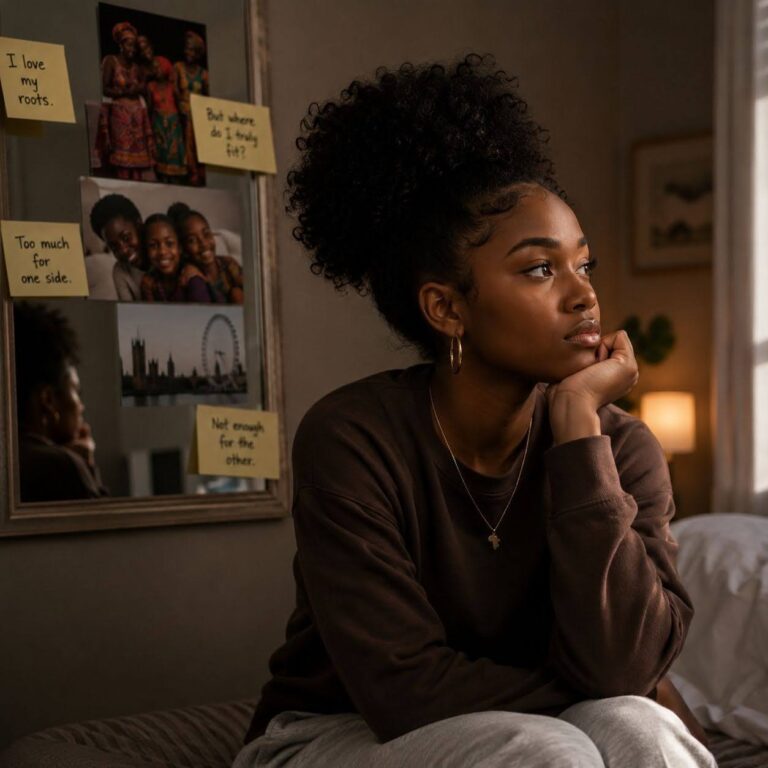
You Were Never Fully One or the other.
At home, you spoke one language. At school, another one. At home, you took off your shoes at the door, ate food your friends had never heard of, and watched your parents navigate a world that was not built for them quietly, fiercely, and without complaint.
Then you stepped outside and became someone slightly different. You laughed at references you had to Google first. You learned to answer “where are you really from?” without flinching. You got very good at code-switching before you even knew there was a word for it.
And somewhere in the middle of all that shifting between who you were at home and who the world needed you to be, you started wondering which one was actually you.
The Question That Follows You Everywhere
If you belong to two worlds, why do you sometimes feel like you belong to neither?
This is the silent struggle nobody prepares you for. Not your parents, who sacrificed too much to acknowledge it. Not your friends, who could not understand it. Not the world, which only ever wanted you to pick a side.
Growing up between two cultures is not just a logistical challenge, learning two sets of rules, two ways of dressing, two ways of speaking depending on the room. It is an identity challenge. Researchers describe this as a bicultural identity, the ongoing, often exhausting process of balancing values, beliefs, and ways of being from two distinct cultural frameworks simultaneously. [¹] And for many people, that process never fully ends.
The tension has a name too: cultural frame switching fatigue, the psychological and emotional cost of constantly shifting between cultural norms depending on who is in the room. [²] It is not weakness. It is the invisible labour of living between worlds.
And that negotiation is exhausting in ways that are hard to explain to people who have never had to do it.
At MyLurah, we’ve built a community where we come together to share our experience and help each other with deep questions that felt unanswered as Black, not for discrimination but for encouragement to embrace our uniqueness with pride.
You feel too African at the dinner table with your colleagues. Too westernised at the family gathering back home. You are asked to be the representative of your culture when it is convenient and told to assimilate when it is not. You carry traditions you were never fully taught and references you were never quite given access to.
The result? A kind of loneliness that lives just beneath the surface. Research confirms that people with low bicultural identity integration that is, those who feel tension rather than harmony between their two cultural worlds face significantly higher rates of depression, anxiety, and acculturative stress. [³] A sense that your full self the version that holds both worlds without apology has never quite had a room of its own.
What Nobody Says Out Loud
This identity tension does not stay in the background. It shows up in your body. In your health. In the way you talk to doctors who do not look like you or understand your lifestyle. In the way you silence symptoms because your culture says to be strong. In the way you feel shame around mental health becauseIn some environments, mental health struggles may be heavily medicalised, while in others they may be interpreted primarily through spiritual, cultural, or moral frameworks.
For Black women especially, this silence runs deep and has a clinical name the Strong Black Woman Schema a cultural expectation to unfailingly display strength, suppress emotions, and be everything to everyone. Research published in the journal Psychology of Women Quarterly found that endorsing this schema was directly linked to increased psychological distress and, critically, self-silencing not speaking up about pain, even when it urgently needs to be heard. [⁴]
In the way you feel shame around mental health, because one world medicalizes it and the other spiritualizes it, and neither ever just sat with you and said this is hard, and you are allowed to say so. Studies on Black women in both the UK and the US show that cultural beliefs around privacy and strength create deeply embedded internal pressure to self-censor to keep mental health struggles firmly behind closed doors, away from community, away from healthcare, and away from help. [⁵]
Chronic stress, emotional suppression, and social isolation can affect mental wellbeing, physical health, and healthcare-seeking behaviours over time..
You Are Not Confused. You Are Complex.
Here is what the silence never let you hear: growing up between two cultures did not make you less of anything. It made you more. Research consistently shows that biculturalism, when embraced rather than suppressed, is linked to greater cognitive flexibility, creativity, empathy, and resilience. [⁶] More perceptive. More adaptable. More fluent in the kind of emotional complexity that most people spend a lifetime trying to develop.
At MyLurah, we believe culturally layered experiences deserve space, conversation, and understanding not simplification
Your identity is not a problem to be solved. It is not a gap to be filled by fully committing to one side. It is yours messy, layered, and entirely valid exactly as it is.
The work is not choosing. The work is giving yourself permission to stop choosing and to rest in the fullness of everything you already have.
You were never too much for either world. Both worlds were just too small for all of you.
References
- Sukha Psychology — Bicultural Identity: Navigating Between Two Worlds: https://sukhapsikoloji.com/bicultural-identity-living-between-two-cultures/
- MindfulSpark — Bicultural Identity: The Mental Health Strengths of Living Between Worlds (Hong et al., 2000): https://mindfulspark.org/2025/10/07/bicultural-identity-the-mental-health-strengths-of-living-between-worlds/
- ScienceDirect — Bicultural Identity Integration, Depressive Symptoms, and Emotional Eating (Chen et al., 2022): https://www.sciencedirect.com/science/article/pii/S1471015324000990
- SAGE Journals — “I’m a Strong Independent Black Woman”: The Strong Black Woman Schema and Mental Health: https://journals.sagepub.com/doi/10.1177/03616843211067501
- SAGE Journals — Dismantling Barriers: Mental Health Stigma and Support-Seeking Behavior Among Black Women in the UK: https://journals.sagepub.com/doi/10.1177/00221678261435219
- MindfulSpark — Biculturalism and Resilience (Nguyen & Benet-Martínez, 2013; Tadmor, Hong & Chao, 2012): https://mindfulspark.org/2025/10/07/bicultural-identity-the-mental-health-strengths-of-living-between-worlds/