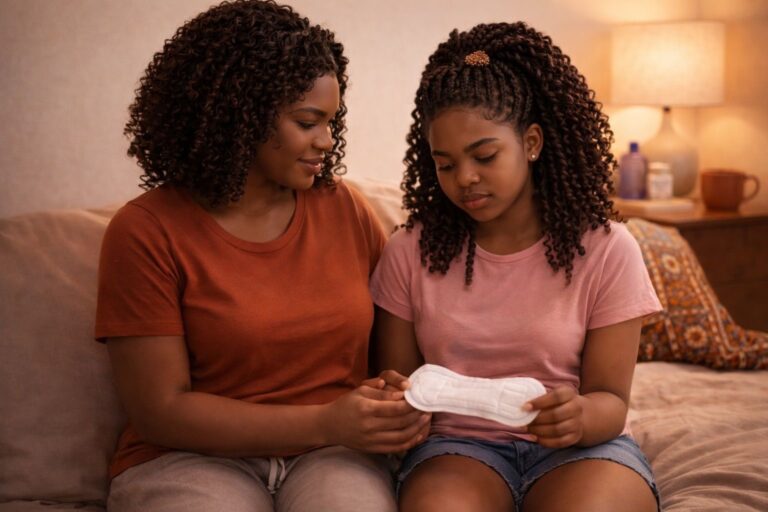
Watching your daughter grow up comes with many milestones, and her first period, known medically as menarche, is one of the most significant.
For many girls, this moment can be confusing, even frightening, especially if they don’t know what to expect. As a parent or caregiver, recognizing the early signs can help you step in with reassurance, support, and the right information at the right time.
Most girls get their first period between the ages of 9 and 16, with the average being around 12 years old.
Signs to Watch Out For
Physical Development Has Already Begun
The first period rarely arrives without warning signs. Months or even years before menstruation begins, the body goes through puberty, including breast development, pubic and underarm hair growth, and a general growth spurt..
If your daughter has been experiencing these changes for about two years, her first period may be just around the corner.
At Mylurah we’re building a digital platform that centers Black women’s reproductive journeys, including culturally sensitive support for Period, Pregnancy and Postpartum. Because representation in care isn’t optional, it’s essential.
Vaginal Discharge
One of the most reliable early signs is the appearance of a white or yellowish discharge in her underwear. This typically begins 6 to 12 months before the first period.
It is the body’s natural way of preparing and cleansing the reproductive system, and it is completely normal.
Abdominal Cramps or Lower Back Pain
She may complain of dull, aching pain in the lower abdomen or back, even before any bleeding starts. These cramps are caused by the uterus contracting, and while they can be mild, they can also be uncomfortable enough to disrupt her daily routine.
Mood Swings and Emotional Sensitivity
Hormonal changes leading up to a first period can cause noticeable shifts in mood. Your daughter may seem more irritable, tearful, or anxious than usual, without a clear reason.
This is a normal response to fluctuating estrogen and progesterone levels.
Bloating and Breast Tenderness
She may notice that her stomach feels fuller or puffier than usual, or that her breasts feel sore or tender to the touch. These are classic premenstrual symptoms driven by hormonal changes.
Fatigue and Headaches
Feeling unusually tired or experiencing mild headaches in the days leading up to her period is common. These symptoms are also hormone-related and tend to ease once menstruation begins.
By joining MyLurah community group, you can take advantage of the platform and improve your chances of meeting people of like mind who are ready to listen to you and offer solutions anytime.
Spotting or Light Bleeding
The first period does notThe first period does not always begin with heavy, noticeable bleeding. Many girls experience spotting, which is small amounts of brown, pink, or red blood in their underwear.
This can be easy to miss or mistake for something else. If you or your daughter notices this, her period has likely begun.
She Seems Uncomfortable or Confused
Sometimes the clearest sign is behavioral. If your daughter seems anxious, is spending more time in the bathroom, or appears visibly uncomfortable without explanation, it may be worth gently checking in with her.
In All You Do:
A girl’s first period is a natural and healthy part of growing up, but it can feel overwhelming without the right support. By recognizing these early signs, you can help your daughter feel prepared, understood, and confident during this transition.
Open, judgment-free conversations about menstrual health go a long way in reducing fear and building trust. Stock the home with period essentials like sanitary pads, help her track her cycle, and remind her that what she is going through is completely normal.
When to See a Professional
While a first period is a normal milestone, there are situations where medical attention is necessary. We strongly advise visiting a qualified healthcare provider or gynecologist if:
- Your daughter is under 9 or over 16 and has not yet started her period.
- She experiences extremely heavy bleeding (soaking more than one pad per hour).
- Cramps are severe enough to interfere with daily activities.
- She has not shown any signs of puberty by age 13.
- The discharge has an unusual color, odor, or is accompanied by itching or irritation.
A healthcare professional can rule out underlying conditions and provide personalized guidance for your daughter’s reproductive health journey. Early consultations are never too soon; they lay the foundation for a lifetime of informed health decisions.