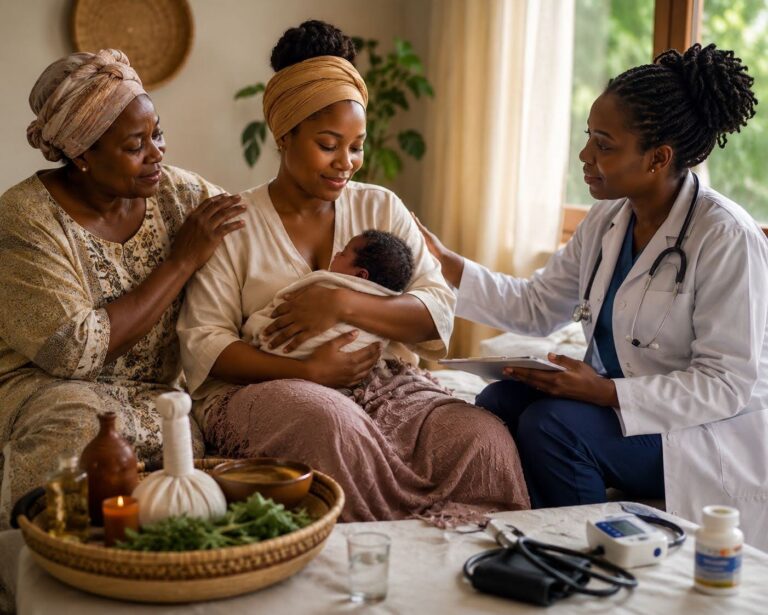
The moment the baby arrives, the world shifts its attention. Suddenly, every question is about the infant the weight, the feeding, the milestones. And the woman who just moved through one of the most physically and emotionally demanding experiences of her life is left to navigate her recovery largely on her own.
For Black women, this is not just a gap in care. It is a pattern with consequences. More than half of all pregnancy-related deaths occur after birth from one day to one year postpartum, and Black women bear a disproportionate share of this burden. [¹] The fourth trimester is not a bonus period. It is where survival happens. And it is where both ancestral wisdom and modern medicine have a role to play.
The Deep Question: What Does It Actually Mean to Heal?
Here is the question that the healthcare system rarely asks Black mothers: What do you need to feel whole again?
Healing after childbirth is not simply the closure of a wound. It is the rebuilding of a body, a mind, and a self and for Black women, that process is shaped by history, culture, and a medical system that has repeatedly fallen short.
The American College of Obstetricians and Gynecologists (ACOG) acknowledges this. In its landmark 2018 Committee Opinion on the “fourth trimester,” ACOG formally recognised that most women in the United States are left to independently navigate the postpartum period until a single visit at four to six weeks a structure it called wholly inadequate.[²] ACOG noted that following birth, many cultures prescribe a 30 to 40-day period of rest and recovery, with the woman and her newborn surrounded and supported by family and community.[²] This is not anecdote. This is cross-cultural evidence that the model matters.
At Mylurah we’re building a digital platform that centers Black women’s reproductive journeys, including culturally sensitive support for Period, Pregnancy and Postpartum. Because representation in care isn’t optional, it’s essential.
Black women across African, Caribbean, and diaspora traditions have long practised versions of this protective model. Community-held postpartum rituals, nourishing soups and herbal preparations, abdominal binding, communal household support, and the presence of elder women as guides are not relics. They are evidence-based practices whose logic modern research is only now catching up with.[³] A peer-reviewed study published in PMC found that culturally traditional postpartum practices including rest, specialised diet, herbal support, and community care were significantly associated with lower rates of maternal depression and better recovery outcomes across cultures.[⁴]
Yet Black women experience postpartum depression at nearly twice the rate of white women, and remain among the least likely to receive diagnosis or treatment.[⁵] A nationally representative study found that white women were nearly twice as likely to receive treatment for postpartum depression as women of colour a disparity rooted not in unwillingness to seek care, but in stigma, systemic racism, and the crushing weight of the “strong Black woman” narrative that discourages disclosure.[⁶]
This is where the blend becomes essential. Modern medicine offers tools that tradition cannot: emergency intervention, pharmaceutical support for severe postpartum depression, cardiovascular screening for conditions like preeclampsia that disproportionately affect Black women. Tradition offers what medicine has failed to provide: rest as a prescription, community as infrastructure, and the radical act of centring the mother’s body and spirit not just her baby’s metrics.
At MyLurah community group, we believe no woman should navigate pregnancy feeling unseen or unsupported. Our platform creates space for culturally informed care, conversation, and community.
The bridge between both is not complicated. It looks like a provider who asks: How are you sleeping? How is your body? How are you feeling in your skin? It looks like a postpartum care plan that includes mental health screening, extended follow-up, and respect for cultural practices rather than dismissal of them.[⁷]
In all you do
Healing is not a six-week appointment. For Black women, real postpartum recovery requires a system that honours both the stethoscope and the soup pot the clinical and the cultural.
The women who came before knew that a mother must be mothered. Modern medicine is slowly learning what Black women have always known. It is time to let both truths heal, together.
References
- ClinicalTrials.gov / ACOG Data – Fourth Trimester: A Web-based Tool for Postpartum Care to Address the Needs of Underserved Women https://clinicaltrials.gov/study/NCT04475718
- American College of Obstetricians and Gynecologists (ACOG) – Optimizing Postpartum Care, Committee Opinion No. 736 | Obstetrics & Gynecology (May 2018) https://www.acog.org/clinical/clinical-guidance/committee-opinion/articles/2018/05/optimizing-postpartum-care
- Monroe, S. – Mothering the Mother: African-American Postpartum Traditions, Recipes, and Healing | Evidence Based Birth® Podcast, Episode 395 (April 2025) https://evidencebasedbirth.com/ebb-395-postpartum-practices-from-african-american-traditions-with-shafia-monroe-midwife-and-author-of-mothering-the-mother/
- Haga, S.M. et al. – Maternal Depression in Rural Pakistan: The Protective Associations with Cultural Postpartum Practices | PMC / NCBI (2020) https://pmc.ncbi.nlm.nih.gov/articles/PMC6964000/
- Waldenu.edu – Factors Contributing to Postpartum Depression Among African American Women (2021) | Walden University Scholarly Works https://scholarworks.waldenu.edu/picportfolios/25
- National Public Radio (NPR) / Children’s Hospital of Philadelphia Research – Black Mothers Get Less Treatment For Their Postpartum Depression (November 2019) https://www.npr.org/sections/health-shots/2019/11/29/760231688/black-mothers-get-less-treatment-for-their-postpartum-depression
- Jeffers, N.K. et al. – “This Year Is Not About Carrying the Heaviest Burden”: A Qualitative Study on Black Women’s Postpartum Experiences | PMC / NCBI (2025) https://pmc.ncbi.nlm.nih.gov/articles/PMC12288716/