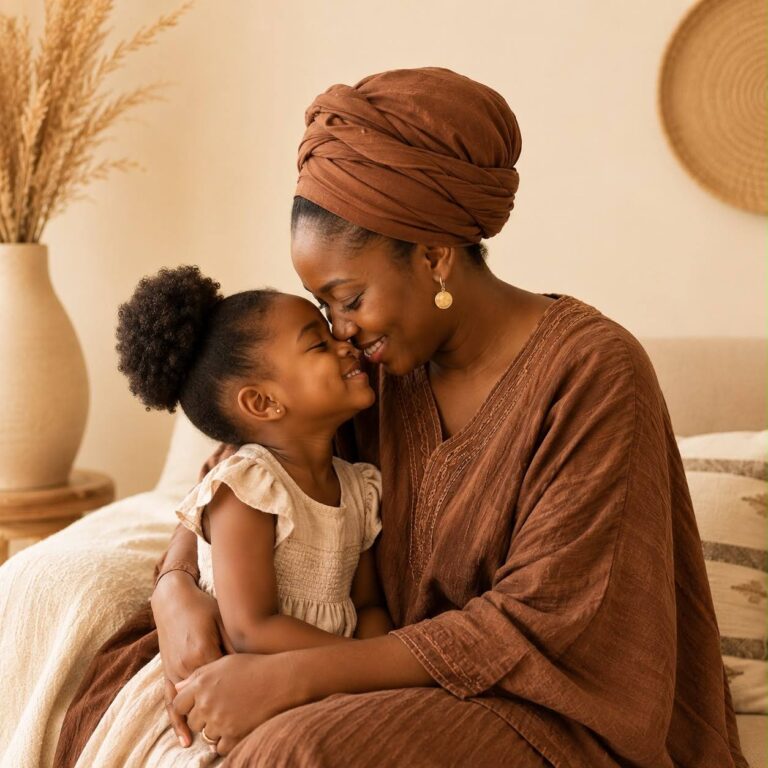
“I Can’t Go to Her When I Have a Problem”
Zainab was sixteen and three weeks late. Terrified, she confided in her best friend, not her mother, the woman who had raised her, fed her, and prayed over her every night. “I can’t go to her when I have a problem,” Zainab admitted later.
“She’d just be disappointed.” It wasn’t that her mother didn’t love her. It was that love, in their home, had never quite made room for these conversations.
This quiet distance present in so many African homes isn’t born of indifference. It’s inherited.
Where the Silence Comes From
Many African mothers grew up in households where sex, bodies, and relationships were never openly discussed, only warned about.
Studies from South Africa describe these conversations as typically didactic, confrontational, and shaped heavily by cultural expectation, with mothers focused mainly on warning and discouraging rather than informing.
This isn’t an unwillingness to care, it’s often a lack of tools. Mothers frequently describe feeling ill-equipped to discuss these topics with their daughters, citing embarrassment, limited knowledge of their own, and a lifelong socialisation into silence around anything sexual.
Many conversations only happen reactively triggered by a pregnancy scare or a school lesson rather than as an ongoing, natural part of parenting.
What the Gap Costs
When mothers and daughters can’t talk openly, both carry the weight of it:
- Daughters turn elsewhere for answers. Research shows that although mothers remain the preferred source of guidance, daughters end up speaking more freely with friends or trusting school-based sex education over their own mothers.
- Risk increases. Girls without access to trusted, accurate information and supportive adults may face greater challenges navigating relationships, contraception, consent, and sexual health decisions.
- The pattern repeats. Young women who wished their own parents had spoken to them more openly often go on to recreate the same silence unless something breaks the cycle deliberately.
At MyLurah, we believe every woman deserves to feel informed, supported, and understood throughout every stage of her reproductive journey. From navigating periods and understanding her body to preparing for pregnancy and adjusting to life after birth, we create a safe space for culturally informed education, meaningful conversations, and community support.
Building the Bridge
Closing this gap doesn’t require perfect knowledge, it requires intention and patience.
Start before there’s a “reason”. Waiting for a crisis to trigger the conversation guarantees it will feel confrontational. Talk early, and keep talking.
Trade warnings for conversations. Instead of “don’t”, try “Tell me what you know” and truly listen before responding.
Admit what you don’t know. It’s okay to say, “I’m not sure, let’s find out together.” That honesty builds more trust than false confidence.
Make space for the harder topics too. Menstruation and abstinence are often the only “acceptable” subjects discussed at home, but pleasure, consent, and relationships matter just as much, and daughters notice the silence around them.
Involve daughters, not just instruct them. Young women themselves say they want detailed, honest conversations not lectures and many say they intend to give their own daughters exactly that.
Closing the Distance
The gap between African mothers and daughters isn’t permanent, it’s a pattern, and patterns can change. Every mother who chooses honesty over silence gives her daughter something rare: a safe place to bring her fears before they become crises.
The goal was never a perfect conversation. It was simply showing up for one.
References
- University of the Free State. (2020). Mother–daughter communication on intimate relationships: narratives from Mangaung Township, Bloemfontein, South Africa. https://scholar.ufs.ac.za/items/7c39d465-0384-49ce-aac2-18359df0ce02
- Jaspan, H., et al. (2022). ‘I can’t go to her when I have a problem’: sexuality communication between South African adolescent girls and young women and their mothers. African Journal of AIDS Research. https://www.ncbi.nlm.nih.gov/pmc/articles/PMC9037167/
- Silberschmidt, M. (2007). Factors inhibiting educated mothers in Kenya from giving meaningful sex-education to their daughters. Social Science & Medicine. https://www.sciencedirect.com/science/article/abs/pii/S0277953606005193
- Shu, V. M. (2026). Sex and Sexuality Communication in African Families in South Africa: The Dynamics of Openness and Closedness. Journal of Family Issues. https://journals.sagepub.com/doi/10.1177/15245004261453769