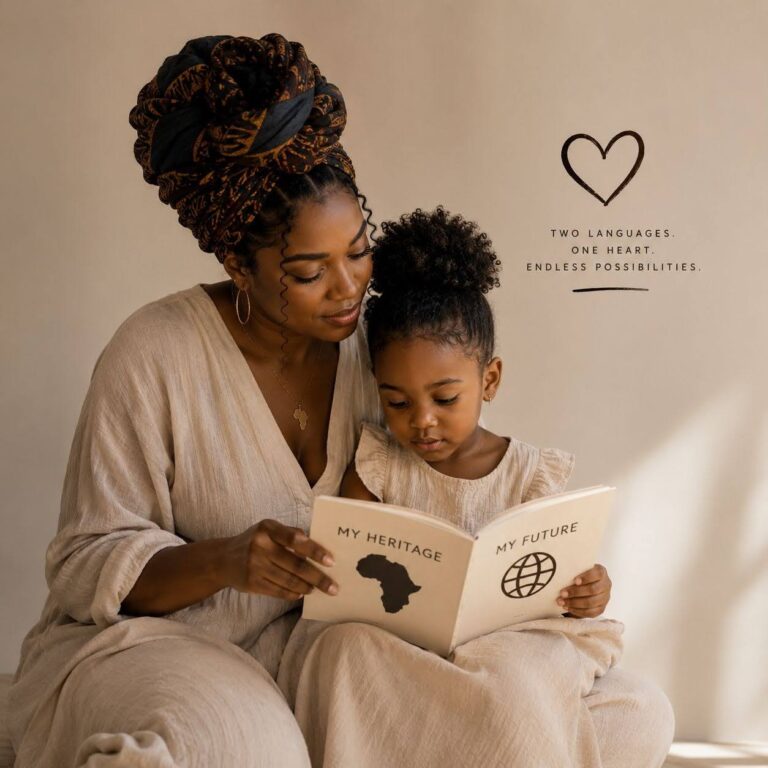
There is a moment many immigrant and diaspora parents know well. Your child comes home from school one day, and the language you have spoken to them since birth the one your mother used, the one woven into your prayers, your proverbs, your grief, starts to sound strange in their mouth. They reach for the dominant language first. And something quietly shifts.
This is not simply a communication issue. It is a cultural one. And what parents do in response, consciously or not will shape not only how their children speak but also who they understand themselves to be.
The Deep Question: Does It Really Matter If My Child Keeps the Language?
Here is the question parents wrestle with, often in silence: If my child thrives in the dominant language, does losing the mother tongue actually cost them anything?
The research answers with a clear and clinically documented yes.
Heritage language loss is not merely a linguistic inconvenience. Studies have found that loss of the heritage language is directly associated with declines in ethnic identity and self-esteem among second-generation youth.[¹] When a child can no longer fully communicate with their grandparents, elders, or extended community in the family’s original tongue, they are not simply losing vocabulary they are losing access to the living transmission of cultural knowledge, values, and belonging. Language, as researchers have consistently framed it, is “an emotional and symbolic bridge to cultural identity, values, and connection” across generations.[²]
For Black and African diaspora families specifically, this cuts even deeper. Research on cultural identity and language use in African diaspora communities confirms that language carries the full architecture of cultural heritage its metaphors, proverbs, relational dynamics, and worldview and that its erosion accelerates the loss of cultural continuity across generations.[³]
Research suggests bilingualism may confer advantages in certain aspects of executive functioning, such as attentional control, cognitive flexibility, and task switching, although findings vary across studies. A landmark review published in PMC by the National Institutes of Health found that bilingual individuals demonstrate better attention, improved task-switching, and stronger cognitive control than monolinguals, attributing this to the brain’s constant exercise of managing two active language systems.[⁴] A 2023 meta-analysis published in ScienceDirect confirmed that bilingual children outperform monolingual children on executive function tasks at a rate significantly above chance, with advantages in monitoring, switching, and inhibitory control.[⁵] These are not small gains. They are the cognitive foundations of academic performance, decision-making, and lifelong adaptability.
At Mylurah we’re building a digital platform that centers Black women’s reproductive journeys, including culturally sensitive support for Period, Pregnancy and Postpartum. Because representation in care isn’t optional, it’s essential.
Crucially, concerns that bilingualism confuses children or delays their development are not supported by evidence. Research confirms that bilingual children reach language milestones at a similar pace to monolinguals and do not show signs of confusion between languages.[⁶]
So what does deliberate language preservation actually look like?
Research from the National Institute of Education in Singapore identifies two evidence-based approaches proven to work in the home.[⁷] The first is the “time and place” method dedicating specific times or settings to the minority language, such as mealtimes, storytelling, or weekend activities. The second is the “one parent, one language” (OPOL) method, where each parent consistently speaks a different language to the child, creating clear and reliable language associations. Both approaches work best when consistency is maintained and the minority language is treated as a living, valued part of daily life not an obligation or a correction.
Beyond method, motivation matters. Research shows that when children understand why their language is important as a bridge to family, culture, community, and identity they engage more autonomously and with greater confidence.[⁸] Language programmes, bilingual storybooks, video calls with relatives abroad, and connection to cultural community groups all function as reinforcement that the minority language has real-world value and emotional resonance, not just classroom utility.[⁹]
In all you do
Preserving a language in a child’s life can have lasting benefits for family connection, cultural identity, and communication across generations.
It is about giving them more: more ways to think, more ways to belong, and more ways to understand the world and the people who came before them.
The language your mother sang to you is worth fighting for and your child is the most powerful reason to begin.
References
- Li (2020); Yu (2015) — Heritage Language Loss and Ethnic Identity — as cited in: Heritage Language and Identity in Mixed Families | AFTJ Journals (2024) https://journals.kmanpub.com/index.php/aftj/article/download/3979/6823/19438
- Ozkaynak (2023); Bayram & Wright (2016) — Beyond the Home: Rethinking Heritage Language Maintenance as a Collective Responsibility | Frontiers in Psychology (May 2025) https://www.frontiersin.org/journals/psychology/articles/10.3389/fpsyg.2025.1616510/full
- Cultural Identity and Language Use in African Diaspora Literature | ResearchGate / University of Nigeria, Nsukka (February 2025) https://www.researchgate.net/publication/388830603_CULTURAL_IDENTITY_AND_LANGUAGE_USE_IN_AFRICAN_DIASPORA_LITERATURE
- Shook, A. & Marian, V. – The Cognitive Benefits of Being Bilingual | PMC / National Institutes of Health (2012) https://pmc.ncbi.nlm.nih.gov/articles/PMC3583091/
- Bilingual Children Outperform Monolingual Children on Executive Function Tasks Far More Often Than Chance: An Updated Quantitative Analysis | ScienceDirect / Developmental Review (2023) https://www.sciencedirect.com/science/article/abs/pii/S0273229723000205
- The Effect of Bilingualism on Children’s Cognitive Development | Alustath Journal, Vol. 62, Issue 4 (2023) https://search.shamaa.org/PDF/Articles/IQAujhss/AujhssVol62No4Y2023/aujhss_2023-v62-n4_387-404_eng.pdf
- National Institute of Education, NTU Singapore – Try These Practical Strategies for Raising Bilingual Kids (March 2025) https://www.ntu.edu.sg/nie/news-events/news/detail/try-these-practical-strategies-for-raising-bilingual-kids
- Wong, K. Ph.D. – The Multilingual Home: Six Evidence-Based Approaches to Raising Bilingual Children (December 2024) https://www.kevin-m-wong.com/blog/2024/12/7/the-multilingual-home-six-evidence-based-approaches-to-raising-bilingual-children
- Harvard Immigration Initiative – Why Heritage Language is Important for Immigrant-Origin Children’s Development and Learning (January 2024) https://immigrationinitiative.harvard.edu/wp-content/uploads/2024/02/JANUARY-2024_WHY-HERITAGE-LANGUAGE-IS-IMPORTANT-FOR-IMMIGRANT-ORIGIN-CHILDRENS-DEVELOPMENT-AND-LEARNING-FINAL.B-1.pdf