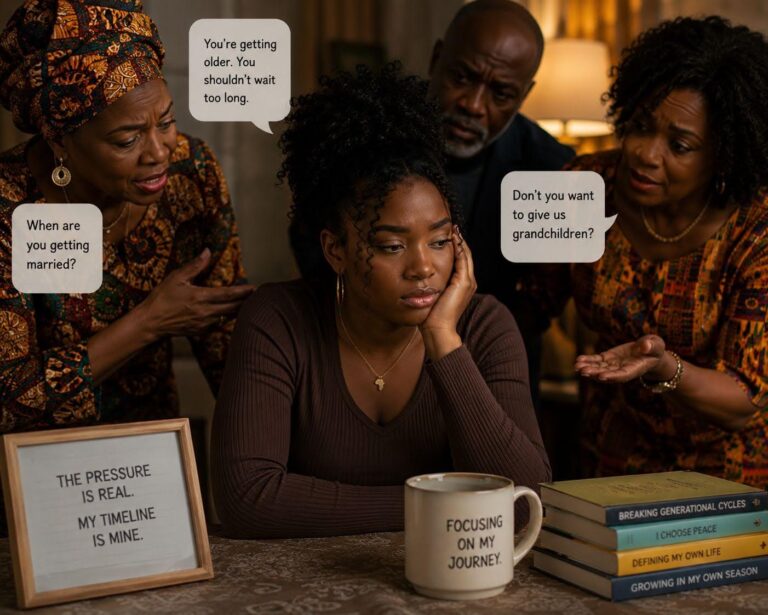
It Started Before You Were Old Enough to Have an Opinion
You were maybe seven or eight the first time someone looked at you and said something like “She’s going to be a beautiful wife someday.” Not a scientist. Not a leader. Not whatever wild, complicated thing you were already becoming in your chest. A wife. Someday.
You filed it away without knowing you were filing it.
Then came the aunties at family gatherings, studying your left hand before they said hello. The casual questions that were never really casual “So when are you settling down?” The comparison to a cousin who just got engaged, delivered with a smile that was also somehow a verdict.
And somewhere along the way, without anyone sitting you down and saying it plainly, you absorbed a truth that was never yours to begin with that your begin to feel as though your value is tied to timelines you never chose.
The Question Nobody Dares Ask the Auntie
Where did this pressure actually come from and does it still make sense for your life
There is what nobody traces back far enough. The urgency around marriage and children for Black and African women did not appear from nowhere. It was built layer by layer from systems that had very specific reasons for wanting women partnered, domesticated, and reproductively active as early as possible.
Colonialism reshaped many African family structures and reinforced patriarchal models of womanhood through law, religion, and social systems. [1]. Before colonial rule, women played central roles as decision-makers, economic contributors, and community leaders roles that were systematically erased and replaced with a narrower, domestic identity [2]. Those models did not leave when colonialism officially ended. They stayed absorbed into culture, into tradition, and into the very language of family gatherings and community expectations.
In many African communities, marriage is not just a personal decision. It is a social contract and a mandatory one. Research confirms that in numerous African societies, members who do not marry at the “appropriate time” are seen as a disgrace to themselves, their family, and the community [3]. Children particularly sons remain the true completion of that contract. A woman without them is spoken of in lowered voices. Prayed over. Worried about. Pitied.
The church did not help. Research shows that in African Christian contexts, marriage largely defines a woman’s moral and social identity and the church actively regulates and enforces norms around marriage building and maintenance [4]. Religious frameworks that elevated wifehood and motherhood as a woman’s highest calling gave the pressure a spiritual wrapper that made it almost impossible to question without feeling like you were questioning God Himself. In many African cultures, motherhood is not even celebrated it is treated as a duty a woman must perform [5].
And social media finished the job. Now the pressure does not just come from your family. It comes from your timeline engagements, baby showers, gender reveals, every milestone arriving in your notifications like a quiet accusation.
At MyLurah, we’ve built a community where we come together to share our experience and help each other with deep questions that felt unanswered as Black, not for discrimination but for encouragement to embrace our uniqueness with pride.
What It Does to a Woman’s Body and Mind
This pressure is not just emotionally exhausting. It is physically felt.
Research on African American women identifies relationships, family, and the burden of social expectations as among the most significant sources of chronic stress [6]. And chronic stress has consequences that go far beyond mood. Studies show that Black women experience what researchers call “weathering” their bodies age faster than their white counterparts due to sustained exposure to chronic stress, leading to higher rates of hormonal disruption, cardiovascular disease, and complications in pregnancy [7].
Women who spend years in the grip of external timelines rushing into relationships they are not ready for, pursuing pregnancies their bodies or circumstances are not prepared for, or silently grieving a life they were never given permission to want carry that tension in their bodies. And they are less likely to seek medical care or speak openly about their experiences because the same culture that pressures them to marry also tells them to suffer quietly [8].
The pressure to marry and have children is not just a dinner table conversation. For Black women, it is a health issue.
You Are Allowed to Want What You Actually Want
Maybe you want marriage and children deeply, genuinely, on your own terms and in your own time. That is valid. Beautiful, even.
Maybe you want one and not the other. Maybe you are still deciding. Maybe you have decided and the answer is neither and you are tired of explaining that to people who have already made up their minds about what your life should look like.
All of it is valid. Every version of it.
The pressure will not disappear overnight. The aunties will keep asking. The timelines will keep arriving. But you are allowed to know clearly, privately, unshakeably that your worth was never attached to a ring or a due date.
It was there before anyone had an opinion about your life. And it will be there long after the questions stop.
By joining MyLurah community group, you can take advantage of the platform and improve your chances of meeting people of like mind who are ready to listen to you and offer solutions anytime.
The pressure will not disappear overnight. The aunties will keep asking. The timelines will keep arriving. But you are allowed to know clearly, privately, unshakeably that your worth was never attached to a ring or a due date.
It was there before anyone had an opinion about your life. And it will be there long after the questions stop.
You are not behind. You are not broken. You are simply living a life that belongs entirely to you and that has always been enough.
References
- Eghafona, K. A. (2021). The Changing Phases of African Marriage and Family: Perspectives on Nigeria in the African Context. Pontifical Academy of Social Sciences. https://www.pass.va/en/events/2021/family_ecology/eghafona.html
- Heinrich Böll Stiftung. (2021). A Critique of Africa’s Post-Colonial Freedoms Through a Feminist Lens: Challenging Patriarchy and Assessing the Gains. https://za.boell.org/en/2021/07/07/critique-africas-post-colonial-freedoms-through-feminist-lens-challenging-patriarchy
- Achembe, M. et al. (2025). The Marriage Debate Among African Christians in the 21st Century: Tradition, Faith, and Emerging Realities. International Journal of Research and Innovation in Social Science. https://rsisinternational.org/journals/ijriss/articles/the-marriage-debate-among-african-christians-in-the-21st-century-tradition-faith-and-emerging-realities/
- PMC / National Institutes of Health. (2024). Same Difference, Different Sameness: Gender-Navigating the Denominational Maze in a Christian African Context. https://pmc.ncbi.nlm.nih.gov/articles/PMC11606533/
- Brennan, V. L. (University of Vermont). Women & Religion in Africa: Sexuality & Motherhood. https://blog.uvm.edu/vlbrenna-rel163/sexuality-motherhood/
- PMC / National Institutes of Health. (2022). A Qualitative Assessment of Gender- and Race-Related Stress Among Black Women. https://pmc.ncbi.nlm.nih.gov/articles/PMC8896166/
- Maternal Mental Health Leadership Alliance. (2024). Black Women, Birthing People, and Maternal Mental Health Fact Sheet. https://www.mmhla.org/articles/black-women-birthing-people-mothers-and-maternal-mental-health-fact-sheet
- PMC / National Institutes of Health. (2008). Race and Gender Matter: A Multidimensional Approach to Conceptualizing and Measuring Stress in African American Women. https://pmc.ncbi.nlm.nih.gov/articles/PMC2553624/